The Aerial Horizon
Forget where your feet are and simply enjoy the view.
Ellipses and Obelisks

Amid the straight line roads of Washington’s grid and diagonal overlays on the horizontal plane, graceful ellipses break the patterns and direct our attention away from our fixation on moving through the city, creating a space in which our attention may fixate on the triumvirate of ideas: Freedom…Service…Sacrifice.
On Memorial Day we reflect on those who have made the ultimate sacrifice to secure our nation’s freedom. We think most about those who have died in action, but others that served valiantly in action and went on to commit their lives to the service of our nation are also central to our thoughts.
The Washington Monument stands as a monument to the man who led us in war and peace, sacrificing his fate for that of his nation. The obelisk emerges from the union of two ellipses inscribed within a third. Wandering these paths around the monument, we reflect on the monument, the object of freedom at the center without contemplating the path we wander. At that moment, we symbolically follow the path of sacrifice and service, abandoning the world around us for our focus on the cause.
Chasing Shadows…Chasing Dreams
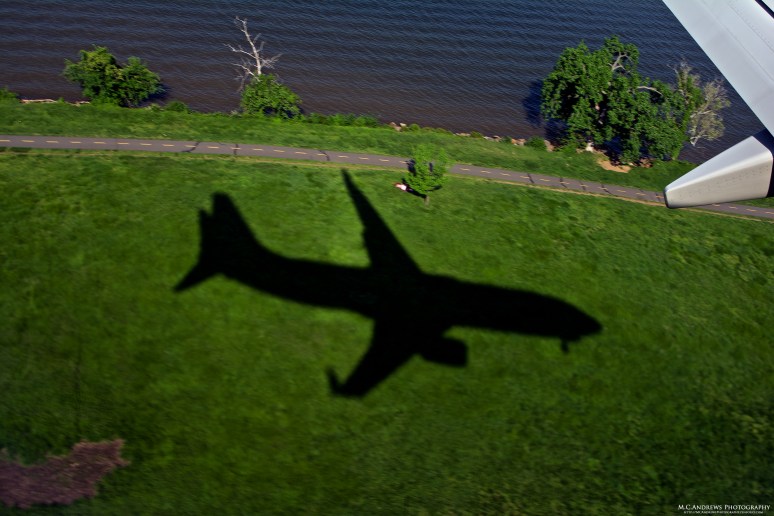
“Like” this or share it if you were ever the kid chasing shadows across an open field dreaming you could fly. I was that kid, maybe you were too…remember that feeling? I thought so.
Pastel Wrinkles – Abstract

Like the deep wrinkles and creases of an aged sunbeaten face in a pastel portrait, the land of the Navajo Indian Reservation in Northeast Arizona is a colorful sculpted monument to the the continent’s past. In this confined view Southwest of Pastora Peak the wrinkles are compressed and their dominant waves cross and scatter. In earthen hues the abstraction is subtle, but when the colors are intensified through saturation, the contrasting layers pop out of the landscape grow more abstract. A beautiful distraction in the corner of a majestic portrait.
A true image, color saturated and polarized.
Dropping in on the Past

Dropping through the clouds, we break out over my hometown…Springfield, Virginia is place that I remember well, but it bears little resemblance to the young suburban community of the 1970s. We all have someplace that we think of as home…these hometowns are entrenched in our memories and we visit them each time we close our eyes and dream of our youth.
Sometimes visiting them in person is less comforting than our memories as the simple things that made our childhoods special may seem to have disappeared. The creek in the woods that we would dam while keeping an eye out for water moccasins now runs under a highway and the woods have been all but paved over. The streets are wider and small-town parades no longer move along them on holidays. Progress and a changing population have changed the physical and social nature of these old suburban neighborhoods. Before lamenting, I think to the moment I popped out of the bottom of the turbulent cloud above…the childlike excitement I found as I looked for my old school and the street where I lived…at that fleeting moment, I was reliving my childhood as if it were all contained in that single burst of emotion.
Although we may visit, we can never really go back to the hometowns we once knew…they exist only in our memories while the places we visit are just that. Time marches on and the gift of aging is that we are around to watch the changes and appreciate the simpler times that we remember…good deep grass stains that will never come out of the patches on my knees, the satisfaction of having climbed a tree, the warm patch of sunshine on my face as I gaze up at the passing clouds, and the thrill of hearing the rumble of a passing jet as it descends over my neighborhood and I dream of being at the controls.
Mount Tipton – Abstract

A saturated view of Mount Tipton transforms the subdued pigments of rocky hills into an ornate piece of native art…the cerulean blue of the Colorado River and Lake Mohave intensifies and bleeds freely through broad veins across the desert into the heart of the mountain where it contrasts with the base of burnt sienna. There the colors twist together and draw our eyes toward the ochre, orange and teal ornament nestled on the southern face of the mountain.
The scene seems unreal…in part because it is an abstract version derived from our imaginations. The soul of the landscape is revealed through the pigments and faint hues that the lens captures, but that we can barely discern. By zooming in, we focus our attention on one minor spot on this vast desert landscape and set our vision apart from reality as we intensify the native colors and enjoy our playground for a little while.
A true image, color saturated and polarized.
Cerulean

As the Colorado River extends south of Las Vegas and wanders through the Mojave Desert, it pauses and widens to form Lake Mohave. There the cerulean pigment is brushed out of the shallows of the pooling river into the gently sloping desert. The colors on the distant aerial horizon blend similarly. Though not through brush strokes, they are blended by the radiant effect of light diffusing in the atmosphere. The palette of the desert is more diverse than one would imagine and it grows more varied as we look deeper into the landscape. The blue, green, yellow, and orange pigments pop out of the landscape as we look down on Mount Tipton on the eastern bank of the Colorado.
A View From the Backseat

When I have to take a seat in the back, I think a lot about the contrast between my world and that of the passenger…As grown-ups we try to change the nature of air travel to suit our needs and we are vexed when the wind and the weather conspire to change our travel plans. When given the chance to sit in an aluminum tube with a hundred and fifty strangers crowded into increasingly narrow seats with finite legroom, many of us do not express a high degree of excitement. Instead, we focus on the negatives of air travel and begrudgingly board the jet because we need to get from point A to point B and we need to get there now.
We know why you fly, but what if you knew how to make flying fun again? The solution is simply to look at the world outside your small portal as a child would see it…express wonder at the weather around you…express excitement when you fly past natural wonders or great monuments…feel as though you are swimming in a great ocean when the winds push you faster or alter your course…Sit back, relax, and enjoy the ride like a kid taking his first ride on an airplane…Grab a window seat, anticipate the sites, and take a few pictures to remember your journey by…And remember that the fun and experience is in “the getting there” and not solely in the business at the other end of the line.
An Island in an Earthen Sea

An apparent island in an earthen sea, this western realm of the Grand Canyon National Park may be part of the north rim but seems to float as an isolated land. With only one dirt road tracing its perimeter, this seems an idyllic place and one from which an intrepid traveler might gain a rare perspective on the canyon below. This is the sort of place I dream of wandering, a place of uncommon beauty lying in the line of common sight yet seeming as though a million miles from everywhere.
“Spring Turning Abstract”
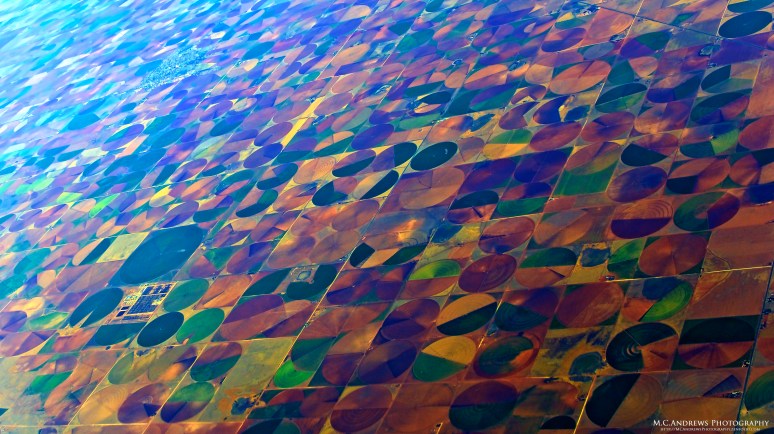
If Grant Wood and Andy Warhol were to have collaborated somewhere over West Texas…I believe the results might have looked something like this wonderfully abstract geometric design showing a modern-style “Spring Turning.” Saturating the fields with color, we see tones and textures that would otherwise have been hidden from our sight.
A true image, color saturated and polarized.
Overhead the Little Colorado River Gorge

From overhead the Little Colorado River Gorge, we see a bright green ribbon of water as it plays hide and seek among the walls of the gorge, twisting and turning along its course. Looking straight down, we get a sense of its depth and the texture of the vertical surfaces of the gorge. It’s a beautiful scene and our elation grows as we experience this view and slide through the sky toward. The Grand Canyon.
Inkblots and Feathers

In the heart of the Mojave National Preserve, the desert terrain appears in inkblots of raised earth and feathered veins of windswept creek beds. Each individual element is an abstraction to itself. Together they are parts of a living spirit in a place on this earth where the way is unencumbered by the will of man to control it.
Tie-dyed – A Grand Canyon Abstract

The Grand Canyon is the diary of our colorful and free spirited planet; its pages left open for us all to see. The ridges and lines of the canyon walls have been colored by time. Each layer is a page in the diary, recording a different moment in the history of the earth. As we read each page from the beginning of time to our most recent moments, the entries grow more colorful and distinct until they diffuse and bleed, taking on the appearance of tie-dyed fabric.
True image, color saturated and polarized.
Broken Bow
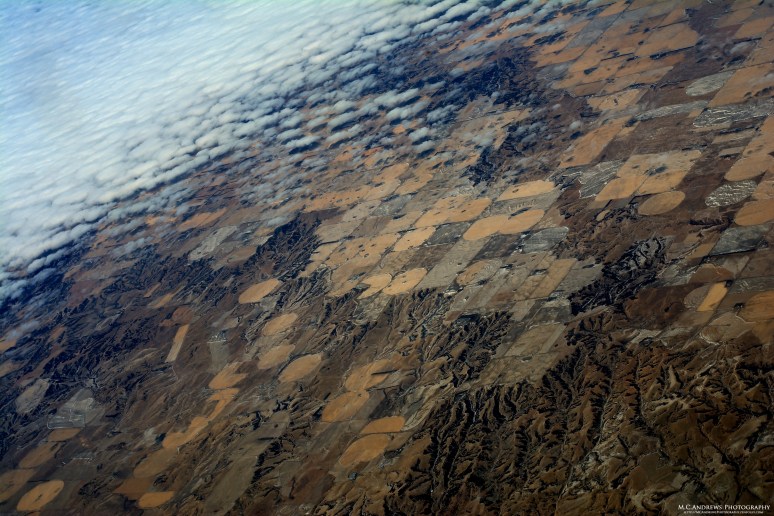
The landscape of the midwest is often full of broad expanses of equally spaced geometric shapes that are the legacy of the planned westward expansion of our country. The ordered divisions of land can be seen in the square grids of farms and towns…But then we get to the edges…the place where order meets the will of a living planet. Northwest of Broken Bow, Nebraska, the flat terrain gives way to the wrinkled crust of earth as we step toward the Rockies. Though invisible in places where the irregular terrain dominates, the grid continues and each level plane is cultivated following its plan. This intermingling of chaos and order creates an abstract landscape that, when combined with textures of weather systems, takes on a view of something out of this world.
“And America undressed herself in front of our eyes”

As I look upon the Little Colorado River Gorge, a song is stuck in my head…Chadwick Stokes of Dispatch fame wrote the song “Adelaide” about a trip he took across America by rail with his brother. His words possess a great sense of visual imagery and I can feel the late day sunlight on my face as the words run through my head and we follow his trek across Northern Arizona on the BNSF line as it crosses the Little Colorado.
“She was dangling her legs over the little Colorado river
Catching the last bit of sunlight in all of Arizona
Told me, Arizona told me.
So I asked her if she wanted to fly
If maybe she needed a ride
Anywhere at all”
The gorge is the first startling crease in the earth that we see as we prepare ourselves for the spectacle of the Grand Canyon. We may mistake it for part of the Grand Canyon National Park, but this area is part of the Navajo Nation and the park is actually known as the Little Colorado River Tribal Park. To follow through on his imagery, this scene becomes all the more awe-inspiring when we think of our land (and earth) as a living being undressing itself to reveal its mysteries to us…if we are willing to take the risk of exploring and embracing her…I forget what the map says and I look to the harmonious flow of water and light across the landscape as they shape and reveal its very nature to us.
Gazing into the Chasm
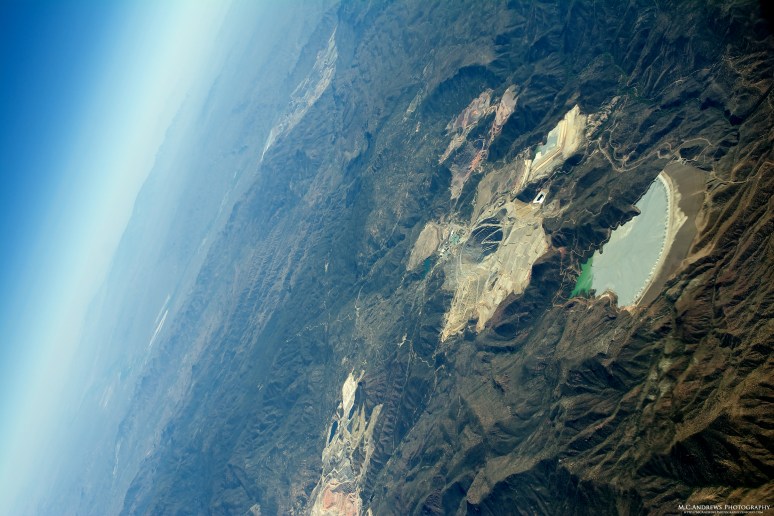 The silver mines opened near Miami, Arizona in 1874, but closed in 1877…When silver mining halted in these mountains, copper mining began almost immediately. The Pinto Valley Copper Mine along with its adjacent mines, look like small deserts nestled in the mountains as we climb out over the range. But as we gain altitude and perspective, the depth of these mines become apparent. The deep white scrapes in the mountain tops first look like divots. They rapidly begin to show depth and spiraling shadows that turn the pitted surface into deep wells of earth. As we look into the chasm, it is as though we are looking at the mountain from the inside out.
Socorro – Abstract
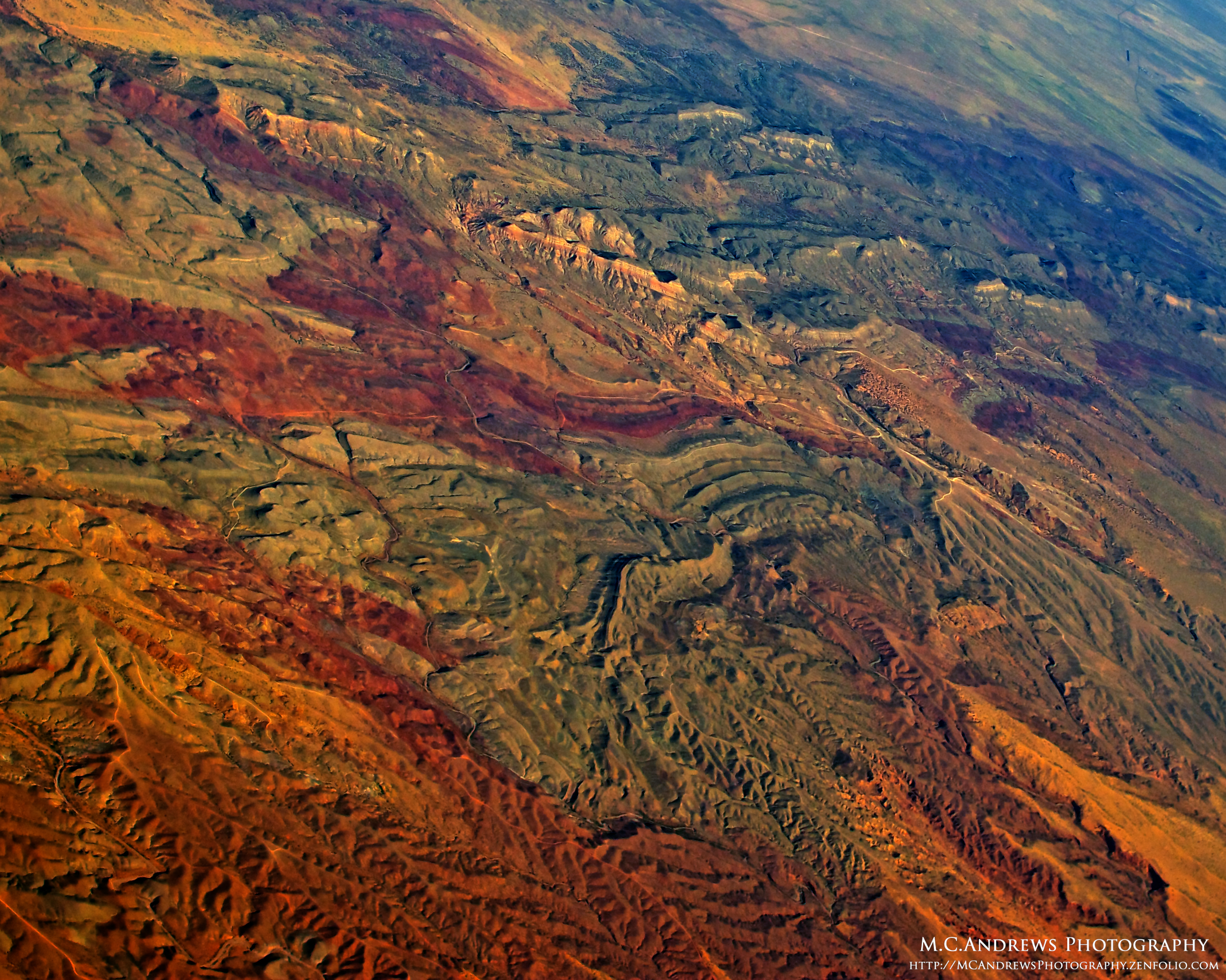
Cropping in to eliminate the outside world, we look at the terrain east of Socorro, New Mexico in the abstract…The depth of the saturated color allows us to imagine the clash of tectonic forces amid a volcanic foment that swirled and heaved to create this landscape along the Rio Grande Rift.
True image, color saturated and polarized.
Contrasting Flows
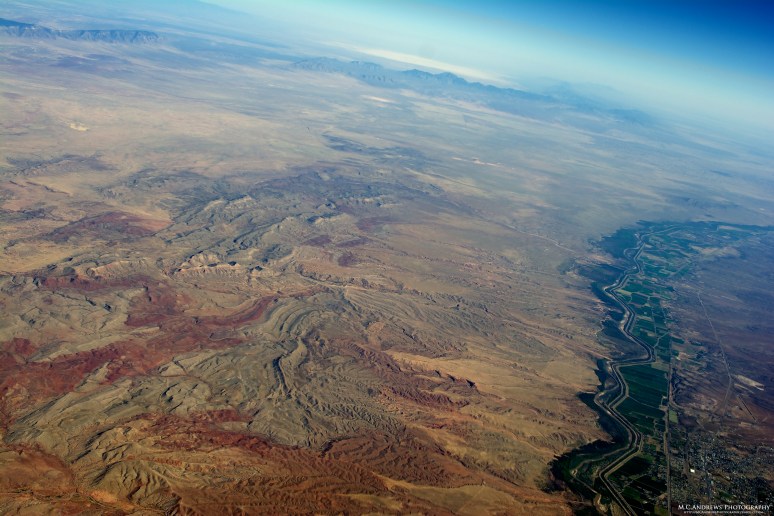
Crossing the Rio Grande at Socorro, New Mexico we experience a contrast in flows…that of water and that of earth.
The Rio Grande flows mostly southward, following a path of least resistance through the Rio Grande Valley. Drawn by the force of gravity, the waters of the river are always falling. Drawn by Coriolis force, the waters are always moving in an anticyclonic flow toward the equator. This seamless flow of water paints a green stripe through the arid landscape…a meandering path of life.
Immediately to the east we see evidence of the tumultuous history of the Rio Grande Rift. The path of earth, in contrast to that of water, is the result of crusting magma flows and the forceful exertions of layered and colliding tectonic plates. Through eons of heaving collisions erratic rippled patterns of multi colored earth have formed and defined the landscape between the ranges of the rift.
The path of earth is shaped by rules and the physical dominance of geological features of great mass forcing their will on the terrain. The discord is memorialized in umber and sienna hues on the twisted and contorted rocky features in a landscape marked by extinct volcanoes. Meanwhile, the path of water is influenced by unseen forces of motion that guide it according to its nature. The harmony is expressed in soothing green and blue hues of growth and life.
In the Moment – III
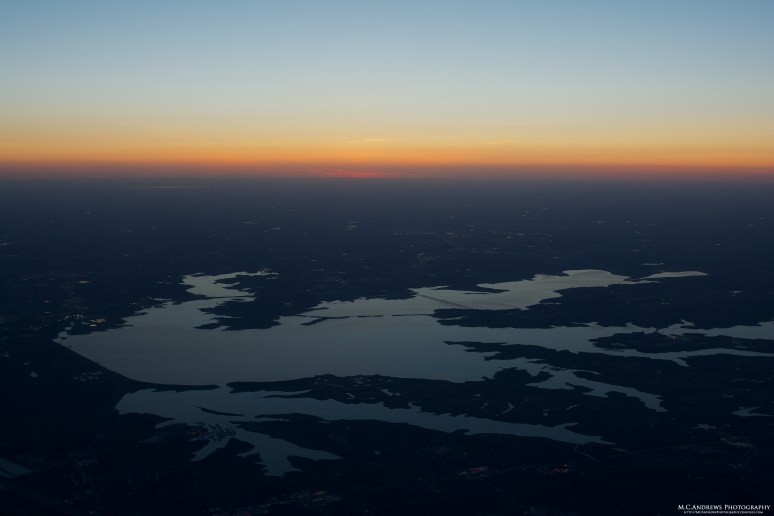
In the moment just after sunset, the sun has dipped completely below the horizon. We are left to look at the landscape of North Texas in the twilight. The long shadows of the afternoon are no longer visible. Instead, the entire landscape is cast in the singular penumbral shadow of the earth. The afterglow of the day illuminates the surface of Lake Lewisville, but our view into the shadows becomes more monochromatic than in the moments before. The reflection on the lake’s surface is that of twilight itself. As the darker umbral shadows of night process across the landscape, we cease to discern the reflections and the once mirrored surface of the lake is consumed by the void of night.
In the Moment – II

In the moment of sunset, the sun rests on the horizon setting it aglow as its articulated rays penetrate the atmosphere and reflect golden on the surface of the Red River. As the river bends and draws the border between Oklahoma and Texas, it pauses momentarily to form Lake Texoma. Hagerman National Wildlife Refuge occupies the southern spur of the lake.
In the Moment – I
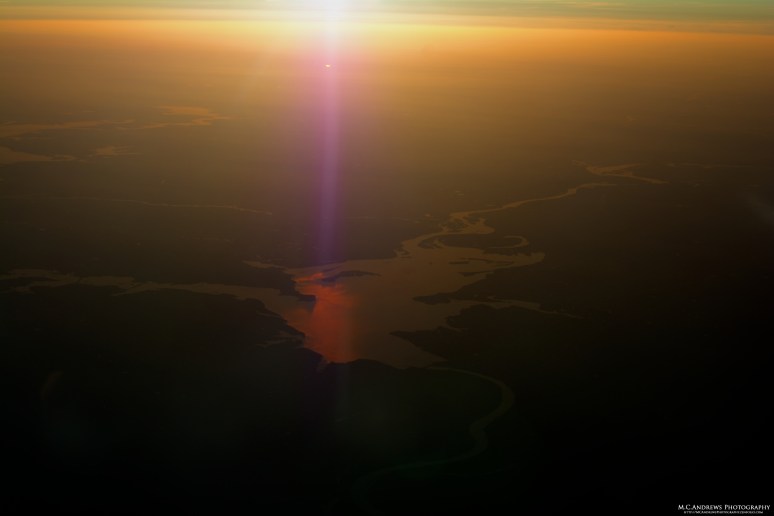
In the moment before sunset, the surface of the Arkansas River catches a sun beam. A few minutes ago, that column of light was bright white and reflected in such a sharp blast that we could not look directly at it…Now, as the sun beam penetrates the particle filled atmosphere, the light is so soft, warm and inviting that we cannot look away from it. Slowly the reflection shifts and withdraws upstream, bathing the Sequoia National Wildlife Refuge in the warmth of the final moments of the day.
The Aerial Horizon – Photography

 The Aerial Horizon